SBLOC vs. HELOC: Borrowing Costs at 6.5% Benchmark Rates
Advertisements
Securities-Based Lines of Credit Versus Traditional Home Equity Loans: Comparing Borrowing Costs at 6.5% Benchmark Rates explores how different collateral requirements, interest structures, fees, and repayment conditions affect borrowing decisions.
A hypothetical 6.5% reference rate provides a starting point for comparing financing costs without assuming that every lender offers identical terms.
The SBLOC vs HELOC comparison matters for borrowers deciding whether to access liquidity through an investment portfolio or use the equity accumulated in their homes.
Advertisements
Both financing options can provide access to substantial funds, but their risks differ because securities-backed credit depends on investment values, while home equity borrowing places real estate at risk.
Understanding interest rates, collateral requirements, repayment conditions, tax treatment, and lender fees helps borrowers compare these alternatives using realistic financial assumptions rather than advertised rates alone.
Understanding Securities-Based Lines of Credit (SBLOCs)
Securities-based lines of credit allow eligible borrowers to obtain financing using qualifying investment assets as collateral without necessarily selling those investments immediately.
These arrangements are generally non-purpose loans, meaning their proceeds cannot be used to purchase or carry certain securities, making them different from traditional margin borrowing.
In an SBLOC vs HELOC evaluation, understanding the risks associated with secured loans is essential because the pledged collateral can be affected when borrowers fail to meet contractual obligations.
Interest Rate Dynamics and Margin Calls
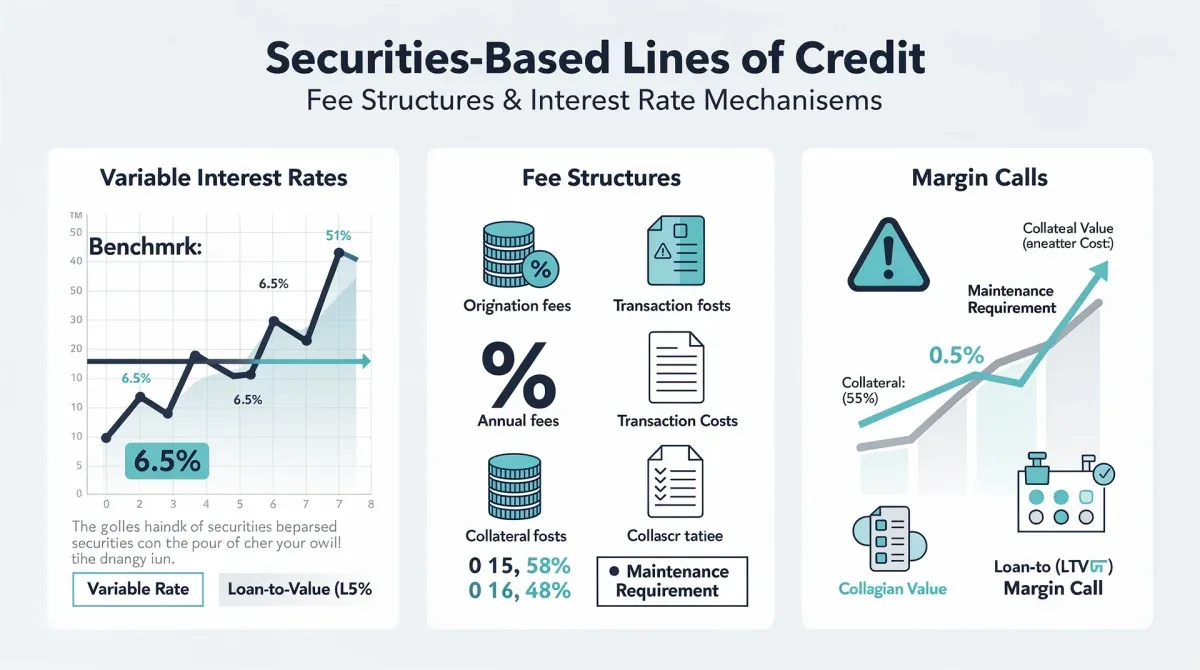
Many securities-based credit lines use variable interest rates calculated from a reference rate plus a lender-specific spread, meaning borrowing costs can change during the loan.
If the value of pledged investments declines, lenders may require additional collateral, partial repayment, or liquidation of securities according to the credit agreement.
When comparing SBLOC vs HELOC borrowing costs, borrowers should evaluate not only interest expenses but also their ability to respond quickly if investment values fall unexpectedly.
Interest Structure: Often variable and linked to a reference rate plus a spread.
Collateral Risk: Declining securities values can trigger demands for additional collateral or repayment.
Liquidity: May provide funds without an immediate sale of existing investments.
Exploring Traditional Home Equity Loans (HELOCs)
Home equity loans and home equity lines of credit both use residential property as collateral, but they differ significantly in how borrowers receive and repay funds.
A traditional home equity loan generally provides a lump sum with scheduled repayments, while a HELOC allows borrowing from an approved credit line during a defined draw period.
Unlike a credit card, a HELOC is secured by the borrower's home, making repayment difficulties particularly serious because foreclosure may be possible.
Fixed vs. Variable Rates in HELOCs
Traditional home equity loans commonly feature fixed interest rates, while HELOCs more frequently use variable rates that can increase or decrease over time.
Some HELOC providers offer options to convert portions of outstanding balances into fixed-rate arrangements, although eligibility, fees, and conditions vary between lenders.
Understanding how interest rates work helps borrowers evaluate SBLOC vs HELOC financing without assuming that a quoted initial rate will remain unchanged.
Home Equity Loan: Generally provides a lump sum with defined repayment conditions.
HELOC: Offers revolving access to available credit during the draw period.
Interest Rates: Fixed and variable options may have different long-term costs.
Comparing Borrowing Costs at 6.5% Benchmark Rates
For illustration, borrowing $50,000 at an annual interest rate of 6.5% would produce approximately $3,250 in simple interest over one year if the principal remained unchanged.
However, a 6.5% benchmark rate is not necessarily the borrower's actual rate because lenders may add a spread, impose fees, or calculate interest differently.
In a realistic SBLOC vs HELOC comparison, the annual percentage rate, repayment structure, outstanding balance, and additional charges must all be considered before determining which option costs less.
Fees and Additional Expenses
Securities-backed credit lines may involve account requirements, collateral maintenance conditions, interest expenses, and lender-specific administrative charges that influence the total borrowing cost.
Home equity products may involve appraisal expenses, origination charges, closing costs, annual fees, or other requirements, depending on the lender and loan structure.
Borrowers comparing SBLOC vs HELOC financing should request written disclosures and calculate total expected expenses over the intended borrowing period rather than focusing exclusively on advertised rates.
Interest: Compare the effective rate applied to outstanding balances.
Fees: Include applicable origination, appraisal, account, and closing costs.
Repayment: Evaluate how quickly principal must be repaid and whether payments can increase.
Risk Assessment and Collateral Implications
Collateral risk is one of the most important differences between securities-backed borrowing and financing secured by residential property.
An SBLOC depends on eligible investment assets maintaining sufficient value, while a home equity product creates a legal claim against the pledged residence.
Evaluating SBLOC vs HELOC borrowing therefore requires understanding what could happen to each collateral asset during financial stress, not simply which loan appears less expensive initially.
Market Volatility and Home Value Stability
Investment portfolios can experience rapid market movements, potentially reducing the value of securities pledged as collateral within a short period.
Residential property values may change more gradually, but declining home prices, payment difficulties, and lender restrictions can still create significant problems for borrowers.
The Consumer Financial Protection Bureau's official comparison of home equity loans and HELOCs explains their structural differences, helping borrowers assess the property-related risks involved.
SBLOC Risk: Investment declines may lead to collateral calls or forced sales.
Home Equity Risk: Failure to repay may result in foreclosure.
Financial Planning: Maintain sufficient liquidity to manage unexpected obligations.
Flexibility and Accessibility of Funds
Both securities-backed credit lines and HELOCs can provide access to funds when needed, although approval procedures and account conditions differ significantly.
SBLOC access may be relatively convenient for borrowers holding sufficient eligible securities, while home equity borrowing typically involves property valuation and mortgage-related underwriting.
For an SBLOC vs HELOC assessment, convenience should be considered alongside repayment obligations, collateral restrictions, and the risk of losing access to additional credit.
Draw Periods and Repayment Structures
HELOCs commonly include an initial draw period followed by a repayment period, during which principal payments may become substantially higher than earlier interest-only payments.
Securities-backed lines of credit may have different repayment conditions, including demand features that permit lenders to request repayment under contractual circumstances.
Comparing these arrangements is an important part of personal financial planning, especially when borrowers expect to maintain an outstanding balance for several years.
Draw Period: HELOC borrowers may access approved funds during a specified period.
Repayment Period: Payment obligations may increase after HELOC draws end.
Demand Features: Some SBLOC agreements permit lenders to request repayment.
Tax Implications and Financial Planning
Potential tax deductions can affect the effective cost of borrowing, but eligibility depends on how loan proceeds are used and whether applicable requirements are satisfied.
Interest on qualifying home equity debt may be deductible when the borrowed funds are used to buy, build, or substantially improve the residence securing the loan.
When reviewing SBLOC vs HELOC tax implications, borrowers should avoid assuming that interest is deductible merely because a loan is secured by investments or real estate.
Interest Deductibility and Use of Funds
Home equity interest used for personal expenses or ordinary debt consolidation generally does not qualify for the federal home mortgage interest deduction.
Traditional non-purpose SBLOCs generally prohibit using proceeds to purchase or carry securities, so borrowers should not assume their interest qualifies as investment interest expense.
For a reliable SBLOC vs HELOC comparison, a qualified tax professional can evaluate the specific loan agreement, use of funds, and applicable federal deduction rules.
Home Equity Interest: May qualify when used for eligible improvements to the property securing the debt.
SBLOC Interest: Deductibility depends on the actual use of proceeds and applicable restrictions.
Documentation: Maintain accurate records explaining how borrowed funds were spent.
Ideal Borrower Profiles for Each Loan
Choosing an appropriate borrowing product depends on available collateral, income stability, financial goals, and the borrower's ability to manage unexpected changes.
Individuals with substantial eligible investment holdings may consider securities-backed credit, while homeowners with sufficient property equity may evaluate home equity products.
Neither option is universally superior in an SBLOC vs HELOC comparison, particularly when the consequences of declining collateral values or repayment difficulties could be substantial.
Who Benefits Most from SBLOCs
SBLOCs may appeal to borrowers who maintain substantial eligible investment portfolios and need temporary access to funds without immediately liquidating those assets.
However, borrowing against investments introduces additional financial risks, including collateral calls, variable interest expenses, and the possibility of forced securities sales.
Before choosing an SBLOC, borrowers should assess whether their available cash reserves and financial circumstances would allow them to manage sudden repayment demands.
Eligible Portfolio: Sufficient qualifying securities are required as collateral.
Risk Capacity: Borrowers must consider potential investment losses and collateral calls.
Repayment Resources: Available liquidity is important when lender requirements change.
Current Market Environment and Future Outlook

Interest rate conditions influence both securities-backed borrowing and home equity financing, particularly when the products use variable rates tied to financial market benchmarks.
The 6.5% figure used in this comparison is an illustrative reference rather than a verified current borrowing rate available from a particular financial institution.
When evaluating SBLOC vs HELOC financing, borrowers should request current lender quotations and consider how changes in interest rates could affect future payments.
Economic Factors Influencing Borrowing Costs
Monetary policy decisions, changes in reference rates, and lender funding conditions can influence interest expenses on variable-rate credit products.
Economic developments may also affect the value of investment portfolios and residential real estate, changing the financial risks associated with each borrowing structure.
Broader indicators, including consumer spending trends, employment conditions, and inflation expectations, provide useful context but cannot determine which borrowing option will be best for every household.
Interest Rates: Variable borrowing costs may change with relevant benchmarks.
Collateral Values: Securities and real estate can both experience declines.
Lender Conditions: Approval requirements and pricing vary across institutions.
Loan Type | Key Comparison at 6.5% Benchmark |
|---|---|
SBLOC | Secured by eligible securities, generally variable-rate, with collateral-call and forced-sale risks. |
HELOC | Secured by home equity, generally revolving and variable-rate, with potential foreclosure risk. |
Fees | Both products may involve interest spreads and additional charges depending on lender terms. |
Tax Implications | Deductibility depends on loan proceeds, applicable restrictions, and federal tax requirements. |
Frequently Asked Questions About Borrowing Options
What is the primary difference between SBLOCs and HELOCs?▼
The main difference is collateral. SBLOCs are secured by qualifying investment securities, while HELOCs are secured by residential property. Both may provide revolving access to credit, but their repayment conditions, collateral risks, and lender requirements differ significantly.
How does the 6.5% benchmark rate affect borrowing costs?▼
A 6.5% benchmark can be used as a hypothetical reference for comparing interest expenses. However, the actual borrowing rate may include an additional lender spread and fees. On a constant $50,000 balance, a 6.5% annual rate represents approximately $3,250 in simple interest over one year.
Are SBLOCs riskier than HELOCs?▼
SBLOCs face the risk of sudden collateral demands when pledged securities decline in value. HELOCs involve different risks, including variable payments and possible foreclosure. Which arrangement presents greater risk depends on the borrower's financial circumstances and the specific loan conditions.
Can I deduct interest paid on both types of loans?▼
Tax deductibility is not automatic. Home equity interest may qualify when funds are used for eligible improvements to the property securing the loan. SBLOC interest requires separate analysis of the use of proceeds and applicable restrictions, especially because traditional non-purpose SBLOCs generally cannot finance securities purchases.
Which loan is better for quick access to funds?▼
SBLOCs may provide relatively convenient access for borrowers holding sufficient eligible investments, while HELOCs commonly require property valuation and mortgage underwriting. However, processing times vary by lender, so neither option guarantees immediate approval or access to funds.
Perspectives
The SBLOC vs HELOC comparison demonstrates how different collateral arrangements can influence borrowing flexibility, repayment obligations, interest expenses, and potential financial losses.
At a hypothetical 6.5% rate, interest calculations provide useful context, but the full cost depends on lender spreads, fees, repayment periods, and the amount actually borrowed.
Borrowers should compare written loan terms, evaluate realistic financial risks, and consider professional guidance before pledging investment securities or residential property to obtain credit.