Optimizing Defined Benefit Pension Cash-Outs: NPV Breakdown
Advertisements
Choosing between a defined benefit pension lump sum and a lifetime annuity requires comparing present values, investment risk, taxes, and retirement income security.
A 20-year example using a $500,000 lump sum and a $3,500 monthly pension shows how the estimated value changes with discount rates. However, longevity, survivor benefits, and payments beyond the projection period remain essential considerations.
Comparing pension lump sum vs. annuity options is one of the most important financial decisions facing workers who have access to a traditional defined benefit pension.
Advertisements
A lump sum offers immediate control of retirement assets, while a pension annuity provides a stream of income that can continue throughout the retiree's lifetime.
This guide presents a 20-year net present value analysis, explains the assumptions behind the calculations, and explores the financial and personal factors that can influence the decision.
Understanding the Pension Lump Sum vs. Annuity Decision
Traditional defined benefit pension plans generally promise retirement income calculated using a formula that may consider earnings, age, and years of service.
Some plans offer eligible participants the choice between receiving periodic pension payments and accepting a one-time lump-sum distribution.
These options have different implications for financial flexibility, investment responsibility, survivor protection, and the risk of running out of retirement savings.
What Is a Defined Benefit Pension?
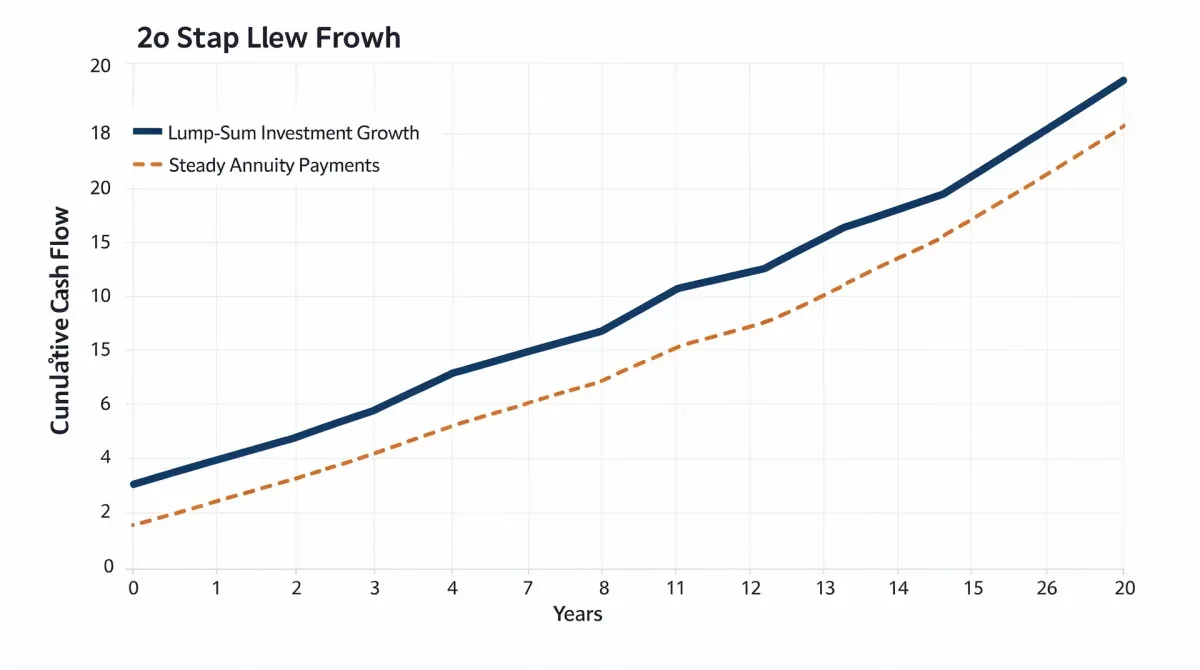
A defined benefit pension is a retirement arrangement that promises benefits according to the plan's established formula.
Unlike a defined contribution account, the participant's pension benefit is not determined solely by the balance of an individually managed investment portfolio.
For qualifying private-sector plans, certain pension benefits may also receive protection from the Pension Benefit Guaranty Corporation, subject to applicable limits.
How a Pension Lump Sum Works
A pension lump sum converts eligible pension benefits into a single payment determined using the plan's applicable calculation rules.
Recipients may have opportunities to invest the funds, use permitted rollover arrangements, or manage retirement distributions according to their circumstances.
However, accepting the payment generally means giving up the corresponding future pension income and assuming responsibility for managing the money.
How a Lifetime Pension Annuity Works
A pension annuity provides scheduled payments, commonly monthly, based on the selected benefit option.
A single-life annuity generally continues while the retiree is alive, while eligible survivor options may provide additional payments after the retiree's death.
The payment amount and available guarantees depend on the pension plan, the participant's circumstances, and the form of benefit selected.
Why Net Present Value Matters in Pension Planning
Net Present Value, or NPV, helps compare payments received at different times by translating future cash flows into an equivalent value today.
For a pension decision, this approach can estimate the present value of scheduled annuity payments and compare it with an offered lump sum.
However, financial value is only one part of the decision because lifetime guarantees and investment uncertainty cannot be fully represented by one calculation.
Understanding the Time Value of Money
Money available today can potentially be invested, making its economic value different from the same amount received several years later.
Discounting adjusts future payments to reflect an assumed annual rate used in the analysis.
The higher the selected discount rate, the lower the calculated present value of a fixed stream of future payments.
Why the Discount Rate Is Important
The discount rate represents an assumption about the time value of future cash flows and should reflect the purpose of the comparison.
Using an expected investment return may help illustrate an opportunity-cost scenario, but investment returns involve risk and are not guaranteed.
When comparing relatively secure pension payments with market investments, analysts should recognize that the two alternatives have different risk characteristics.
Why Use a 20-Year Projection?
A 20-year projection creates a manageable period for comparing monthly pension payments with an immediate lump-sum offer.
It allows readers to evaluate different discount rates and understand the sensitivity of the financial result.
Nevertheless, lifetime pensions may continue beyond twenty years, so a finite projection should not be mistaken for a complete lifetime valuation.
A 20-Year Pension NPV Example
Consider a hypothetical retiree choosing between a $500,000 lump-sum pension payment and an alternative paying $3,500 per month for life.
For the initial comparison, assume monthly payments remain constant and the analysis covers only the first twenty years.
The following calculations exclude taxation, mortality probabilities, survivor benefits, and any payments received after the twentieth year.
Step 1: Identify the Pension Alternatives
The lump-sum option provides $500,000 immediately, establishing a starting present value of $500,000 before any applicable taxes or transaction considerations.
The annuity alternative provides $3,500 per month, equivalent to $42,000 annually before taxes.
Over 240 monthly payments, the annuity would deliver $840,000 in undiscounted nominal payments if the recipient received every scheduled payment.
Step 2: Calculate the Present Value of Monthly Payments
The present value of a level monthly payment stream can be calculated using an ordinary annuity formula.
For this illustration, the annual effective discount rate is converted into an equivalent monthly rate, and the 240 payments are assumed to arrive at the end of each month.
The calculation is expressed as PV = PMT × [1 − (1 + r)^−n] ÷ r, where PMT is the monthly pension, r is the monthly discount rate, and n is the number of payments.
Step 3: Compare Results at Different Discount Rates
At a 3% effective annual discount rate, the present value of the 240 monthly payments is approximately $633,400.
At a 5% effective annual rate, the estimate declines to approximately $535,302, while a 7% rate produces approximately $459,050.
These results demonstrate how the assumed discount rate can change the financial comparison even when the pension payment and lump-sum offer remain unchanged.
Step 4: Find the Break-Even Discount Rate
The break-even discount rate is the rate at which the present value of the projected annuity payments equals the offered lump sum.
In this example, the twenty-year payment stream has a present value of approximately $500,000 when discounted at an effective annual rate near 5.87%.
This is a mathematical comparison point, not a promised investment return or evidence that one alternative is automatically preferable.
Step 5: Interpret the Results Carefully
At a lower discount rate, the present value of the annuity payments exceeds the offered lump sum under the stated assumptions.
At a higher discount rate, the fixed twenty-year annuity payments have a lower present value than the immediate payment.
However, payments continuing after twenty years may increase the annuity's lifetime economic value, while earlier death can reduce the payments received under a single-life arrangement.
What the 20-Year Calculation Does Not Capture
A simplified NPV calculation compares scheduled cash flows but does not fully represent the uncertainty surrounding retirement outcomes.
Investment returns, longevity, inflation, and personal circumstances can produce results that differ substantially from an initial projection.
Understanding these limitations is necessary before using an NPV estimate to make an irreversible pension election.
Payments Beyond Year Twenty
A retiree who continues receiving a lifetime annuity after the twentieth year may collect additional monthly payments for many more years.
Those payments are excluded from a calculation that stops after 240 months.
Consequently, the twenty-year NPV should be supplemented with longer planning horizons or a lifetime probability-based analysis.
Mortality and Life Expectancy
A single-life pension generally ends when the recipient dies, regardless of whether that occurs before or after the projected period.
A mortality-weighted valuation can estimate the probability of receiving each future payment using appropriate actuarial assumptions.
Personal health, age, and the selected benefit option also influence the practical value of the pension.
Investment Return Uncertainty
The lump-sum alternative may produce positive investment returns, but market performance can vary substantially from year to year.
A fixed assumed return does not capture the full range of possible outcomes, including periods of negative investment performance.
Retirement planning should therefore consider unfavorable scenarios rather than relying entirely on a single expected return.
Evaluating the Lump-Sum Cash-Out Option
A lump-sum distribution may appeal to retirees who want greater flexibility over investments, withdrawal timing, and potential estate planning.
It also transfers investment management responsibilities and market risk from the pension payment arrangement to the individual.
The value of that flexibility depends on the retiree's financial resources, experience, objectives, and ability to tolerate uncertainty.
Investment Flexibility and Portfolio Construction
Recipients may be able to allocate eligible rollover assets among different types of investments according to their risk tolerance and financial goals.
A diversified investment strategy may combine assets intended to support current spending with those providing longer-term growth potential.
No portfolio allocation can guarantee that investment returns will exceed the value of a lifetime pension.
The Risk of Early Retirement Losses
Sequence-of-returns risk occurs when the timing of investment gains and losses affects the sustainability of retirement withdrawals.
Large portfolio losses early in retirement can be especially damaging if withdrawals continue while asset values remain depressed.
Two portfolios with similar average returns may produce very different retirement outcomes when their annual return patterns differ.
Withdrawal Strategy and Portfolio Longevity
Retirees who accept a lump sum must determine how much money can be withdrawn without creating an unacceptable risk of depletion.
The appropriate withdrawal strategy depends on expected expenses, investment performance, inflation, taxes, and the availability of other income.
A sustainable plan should be reviewed periodically rather than assuming a fixed withdrawal percentage will remain suitable in every market environment.
Investment Fees and Advisory Costs
Investment management expenses can reduce the amount of wealth remaining in an account and affect long-term retirement income.
These expenses may include fund operating costs, advisory fees, custodial charges, and other applicable costs.
Any comparison between a pension annuity and an invested lump sum should account for reasonably expected fees.
Evaluating the Lifetime Annuity Option
A lifetime pension annuity offers predictable scheduled payments and reduces the need to manage the corresponding retirement assets directly.
Its principal advantage is protection against the risk of outliving the income stream, subject to the terms and security of the benefit arrangement.
However, annuity payments may provide less liquidity and may lose purchasing power when they are not adjusted for inflation.
Single-Life Pension Payments
A single-life annuity generally pays benefits throughout the participant's lifetime and stops when that person dies.
Because it does not provide continued lifetime payments for a surviving spouse, this option may offer a higher initial monthly amount than comparable survivor arrangements.
Its suitability depends on whether anyone else relies on the pension income and whether other financial protection is available.
Joint-and-Survivor Annuities
A joint-and-survivor pension provides continued benefits to a qualifying survivor according to the selected payment arrangement.
Depending on the available plan choices, the survivor may receive a specified percentage of the original pension after the participant's death.
The initial payment is generally lower than a comparable single-life pension because the benefit may continue across two lifetimes.
Period-Certain Pension Arrangements
Some pension plans offer benefit arrangements with a guaranteed minimum number of payments or other beneficiary provisions.
These arrangements can provide additional protection if the participant dies before the specified period has ended.
The available choices and beneficiary rules depend on the plan, making its official election documents important.
Inflation and Purchasing Power
A fixed pension payment may become less valuable in purchasing-power terms as prices rise over time.
For example, $3,500 per month will purchase fewer goods and services after prolonged inflation unless the payment increases.
Some pensions contain cost-of-living provisions, but retirees should confirm whether their particular plan includes them.
How Interest Rates Affect Pension Lump Sums
Interest rates can influence the calculation of a pension lump-sum offer because converting future benefits into a present amount requires actuarial assumptions.
The applicable rates and methodologies depend on federal requirements and the particular plan's provisions.
As a result, changes in the interest-rate environment may alter lump-sum offers even when the underlying pension benefit formula has not changed.
Interest Rates and Present Value
Higher discount rates generally reduce the present value of a fixed future payment stream.
Lower discount rates generally increase that present value when other assumptions remain constant.
This mathematical relationship helps explain why certain pension lump-sum calculations can be sensitive to changes in relevant interest rates.
Why Plan-Specific Rules Matter
Qualified defined benefit plans may use statutory interest-rate and mortality assumptions when calculating certain lump-sum distributions.
Plan provisions determine how applicable dates and calculation rules interact with the participant's retirement election.
Retirees should request a written explanation of the actual offered amount rather than estimating their pension cash-out solely from market interest rates.
Comparing Borrowing and Retirement Assets
Some retirees also evaluate borrowing against investments or other assets when planning liquidity needs.
However, borrowing strategies introduce repayment obligations and separate risks that should not be confused with the value of a pension distribution.
For broader financial context, this comparison of securities-backed lines of credit and home equity borrowing costs discusses distinct financing arrangements.
Tax Considerations for Lump Sums and Pension Payments
Tax treatment can significantly influence the net amount available from a pension decision.
Periodic pension income and lump-sum distributions may both involve federal income tax obligations, but eligible rollover arrangements can change when taxation occurs.
Taxpayers should evaluate their circumstances before deciding whether to receive funds directly or transfer them to another eligible retirement account.
How Pension Annuity Payments Are Taxed
Taxable pension payments generally count as income under the applicable federal income tax rules.
Some participants may have an after-tax investment in the pension contract, potentially affecting the taxable portion of payments.
The IRS provides guidance through Publication 575 and other resources concerning pension and annuity income.
Taxation of a Lump-Sum Cash Distribution
A taxable pension distribution received directly may increase income for the year and create a substantial federal tax obligation.
The final liability depends on factors such as the distribution's taxable portion, other income, deductions, and applicable tax rules.
Accepting a large cash payment without evaluating taxation can materially reduce the amount available for retirement.
Direct Rollovers to Eligible Retirement Accounts
Eligible lump-sum distributions may be transferred directly to a qualified retirement plan or IRA that accepts the rollover.
A qualifying direct rollover generally avoids the mandatory 20% federal withholding applicable to many taxable distributions paid directly to individuals.
Taxes may still apply when the money is later withdrawn, depending on the account type and applicable distribution rules.
The 60-Day Rollover Rule
When an eligible retirement plan distribution is paid to the participant rather than transferred directly, a 60-day rollover may be available.
However, mandatory withholding can create complications because the participant may need additional funds to roll over the full eligible amount.
Direct rollovers are often administratively simpler, but the appropriate choice depends on the transaction and the applicable IRS rules.
Early Distribution and Other Tax Risks
Certain taxable retirement distributions made before age 59½ may be subject to an additional early distribution tax unless an exception applies.
Exceptions can depend on the participant's age, separation from service, plan type, and other qualifying circumstances.
A tax professional can help evaluate these issues before a distribution is requested.
Spousal Protection and Beneficiary Planning
Pension elections can affect the financial security of a spouse or other eligible beneficiary after the participant's death.
Some retirement plans must offer particular survivor protections to married participants under applicable federal law.
These requirements should be reviewed before treating a lump sum and a single-life annuity as directly interchangeable options.
Qualified Joint-and-Survivor Protection
Many qualifying pension plans provide a qualified joint-and-survivor annuity as the standard form for married participants.
Electing a different payment form can require informed spousal consent under applicable requirements.
Plan administrators should provide relevant information about available benefit forms and associated survivor protections.
Passing Remaining Lump-Sum Assets to Heirs
Funds remaining in an eligible retirement account after the participant's death may pass to designated beneficiaries according to account rules.
However, inherited retirement accounts have tax and distribution requirements that depend on the beneficiary and account type.
Beneficiary flexibility is therefore useful but should not be assumed to eliminate all restrictions on inherited funds.
Evaluating Family Income Needs
A surviving spouse may need predictable income for housing, healthcare, and other ongoing expenses.
A joint-and-survivor pension can help address this need, although it generally reduces the participant's initial monthly payment.
The decision should consider other retirement income, savings, life insurance, and the financial circumstances of both partners.
Pension Security and PBGC Protection
Defined benefit pensions are subject to funding and regulatory requirements intended to support promised retirement benefits.
The Pension Benefit Guaranty Corporation provides insurance protection for eligible private-sector defined benefit pension plans under applicable federal rules.
However, PBGC protection has limits and does not guarantee every promised payment in every circumstance.
What PBGC Generally Covers
PBGC protects certain benefits under eligible private-sector defined benefit pension plans when qualifying circumstances arise.
The level of guaranteed benefits depends on applicable limits, benefit types, and other statutory requirements.
Participants should verify whether their pension is covered and understand how the guarantee rules apply to their situation.
Why Pension Funding Still Matters
Plan funding information can provide context about the financial position of a defined benefit arrangement.
However, funding ratios alone do not fully describe every risk associated with a pension or its applicable legal protections.
Retirees should review official plan disclosures and ask the administrator for clarification when important information is unclear.
Comparing Security With Investment Control
A lifetime pension provides defined payment obligations under its terms, while a lump sum gives the retiree control over the corresponding assets.
Neither arrangement should be described as completely risk-free, because each involves different legal, financial, and practical considerations.
The preferred balance between predictable income and investment flexibility depends on individual circumstances.
Illustrative Retirement Scenarios
Hypothetical examples help demonstrate how different retirement priorities can influence pension decisions.
These scenarios do not predict investment returns or establish which option will produce the highest lifetime benefit.
Instead, they show why an NPV comparison should be considered alongside household financial goals.
Scenario 1: A Retiree With Other Stable Income
Consider a retiree who already receives sufficient stable income to cover most essential living expenses.
That person may place greater value on investment flexibility, liquidity, and the ability to manage assets for beneficiaries.
A lump sum could be worth evaluating, although market risk and the possibility of poor withdrawal outcomes remain important.
Scenario 2: A Retiree Prioritizing Reliable Income
Consider another retiree who expects the pension to cover a substantial portion of recurring household expenses.
For this person, predictable lifetime payments may be particularly valuable because they reduce dependence on investment withdrawals.
A pension annuity may align well with that objective even when certain investment scenarios show a higher projected portfolio value.
Scenario 3: A Married Couple Planning Survivor Income
A married couple may need retirement income to continue after the first spouse dies.
A qualified joint-and-survivor annuity may provide this protection, but its payment amount will differ from a single-life pension.
Comparing the lump sum against the correct survivor annuity is essential for a meaningful financial analysis.
Scenario 4: A Retiree With Significant Liquidity Needs
Some retirees anticipate major expenses for housing, family support, healthcare, or other financial obligations.
A lump sum may offer greater control over the timing of withdrawals than a fixed monthly pension.
However, using retirement assets for large early expenses can reduce future income security and should be evaluated carefully.
How to Make a More Complete Pension Comparison
A strong retirement analysis combines financial calculations with a clear understanding of the pension plan and household needs.
Written plan quotations should provide the starting point for evaluating payment forms, lump-sum calculations, and survivor options.
Additional scenarios can then illustrate the effect of taxes, inflation, mortality, investment performance, and retirement spending.
Request All Available Pension Options
Ask the plan administrator for official quotations covering the lump sum and relevant annuity payment forms.
Review available retirement dates, survivor percentages, guaranteed payment provisions, and any benefit adjustments.
Confirm whether the quoted amounts are final or subject to recalculation before the actual commencement date.
Use Consistent Financial Assumptions
Compare alternatives using the same valuation date, currency basis, and appropriately matched assumptions.
Do not add the projected future value of the lump sum to its original value, since doing so can double-count the same asset.
When evaluating a withdrawal portfolio, calculate its expected cash flows and remaining value consistently rather than treating all figures as independent gains.
Include Taxes and Fees
Consider how pension payments, retirement account withdrawals, investment expenses, and applicable taxes affect net retirement income.
Tax differences may alter the comparison even when the pretax present values appear similar.
Professional advice may be especially useful when a lump sum creates complex rollover or distribution decisions.
Test Longer Lifespans and Lower Returns
Extend the planning horizon beyond twenty years to understand how continued lifetime pension payments could change the results.
Test unfavorable investment returns and higher-than-expected expenses when examining the lump-sum alternative.
A decision that appears attractive under optimistic assumptions may be less appealing when retirement lasts longer or markets perform poorly.
When to Seek Professional Financial Guidance
Pension elections can be difficult to reverse once benefits begin or a lump sum is distributed.
Retirees should understand the consequences of the available choices before accepting a payment form.
Qualified financial and tax professionals can help analyze the decision using the actual plan terms and household circumstances.
Before Accepting a Lump-Sum Offer
Review the offer amount, available annuity alternatives, applicable deadlines, and rollover instructions.
Determine how the distribution would affect retirement income, tax obligations, and other financial goals.
Do not assume that receiving the entire amount in cash is necessary when an eligible direct rollover may be available.
Before Electing a Survivor Annuity
Compare single-life and joint-and-survivor payments using the actual plan's available percentages and conditions.
Consider whether a spouse or other beneficiary depends on the pension for essential expenses.
Understand any required consent procedures and whether the chosen form can be changed after payments begin.
During Overall Retirement Planning
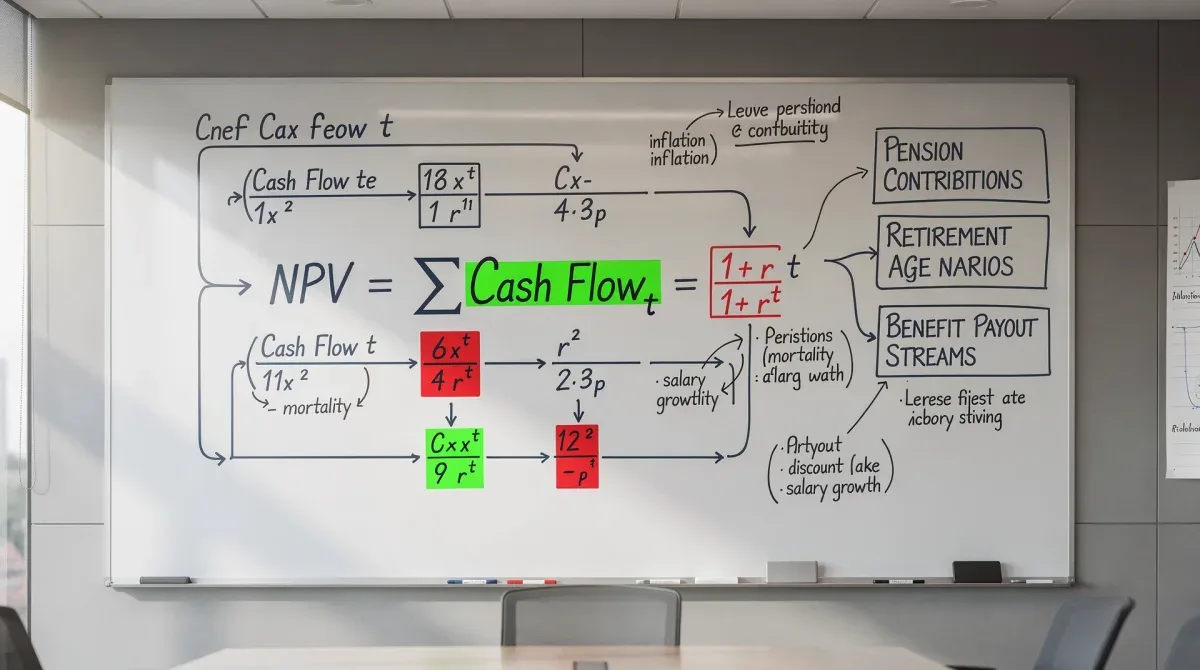
Retirement planning should incorporate expected expenses, Social Security benefits, other pensions, savings, healthcare needs, and inflation.
A pension choice that works well in isolation may need adjustment when considered alongside the complete household financial picture.
Periodic reviews can help manage the assets and income remaining after the pension election has been made.
Key Takeaways From the Pension Cash-Out vs. Annuity Comparison
A lump sum provides investment flexibility and potential liquidity, while an annuity provides scheduled income and may include lifetime survivor protection.
The twenty-year NPV example shows that discount-rate assumptions materially influence the estimated value of a fixed pension payment stream.
The original table below summarizes important personal factors that should be evaluated alongside the financial calculations.
Key Consideration | Impact on Decision |
|---|---|
Investment Acumen | Investment experience can help with lump-sum management, but does not guarantee better financial results. |
Risk Tolerance | Greater willingness and capacity to accept market risk may make a lump sum more suitable. |
Longevity Expectations | Longer retirement periods increase the potential value of payments that continue for life. |
Spousal Protection | Joint-and-survivor pension arrangements may provide continued income for an eligible surviving spouse. |
Frequently Asked Questions About Pension Lump Sums and Annuities
What is the difference between a pension lump sum and an annuity?
A lump sum provides an eligible one-time distribution, while a pension annuity pays benefits on a scheduled basis, commonly for the recipient's lifetime.
Is a pension lump sum always better than monthly payments?
No. The result depends on the offered amounts, investment risk, lifetime income needs, taxes, and personal circumstances.
What is NPV in pension planning?
Net Present Value estimates what future pension payments are worth today using an assumed discount rate.
Why use a 20-year NPV comparison?
Twenty years provides a useful illustration of long-term payments, but a lifetime pension may continue beyond the projection period.
How much is a $3,500 monthly pension worth over 20 years?
It pays $840,000 over 240 months before discounting, taxes, and adjustments, assuming all scheduled payments are received.
What is the present value at a 5% discount rate?
Under the example's assumptions, the twenty-year payment stream has a present value of approximately $535,302.
What is the break-even rate for a $500,000 lump sum?
With $3,500 monthly payments over twenty years, the effective annual discount rate producing approximately $500,000 in present value is 5.87%.
Does the calculation include lifetime payments after twenty years?
No. The example includes only the first 240 monthly payments, so it does not fully value a lifetime annuity.
Can I invest a pension lump sum?
Eligible distributions may be invested or transferred to qualifying retirement accounts, subject to applicable plan and tax requirements.
Can a pension lump sum be rolled into an IRA?
Many eligible pension distributions can be transferred through a qualifying rollover, although plan provisions and federal rules determine availability.
Is there a 20% withholding requirement for lump sums?
Most taxable eligible rollover distributions paid directly to participants are subject to mandatory 20% federal withholding, while qualifying direct rollovers generally avoid it.
Can my spouse receive pension payments after I die?
Some plans provide joint-and-survivor benefit options that continue qualifying payments to a surviving spouse according to the selected terms.
Does PBGC guarantee every pension payment?
No. PBGC provides protection for eligible pension plans, but statutory limits and other restrictions can affect guaranteed benefits.
What happens if my retirement investments lose value?
A lump-sum portfolio may decline in value, potentially requiring spending adjustments or increasing the risk that retirement savings are depleted.
Should I consult a financial advisor before choosing?
Professional guidance can help evaluate actual pension quotations, taxes, survivor benefits, investment risks, and retirement income requirements.
Conclusion
The pension lump sum vs. annuity decision requires balancing immediate asset control against predictable retirement income and potential lifetime protection.
A twenty-year NPV analysis provides a useful financial comparison, but its results depend on discount-rate assumptions and cannot fully capture longevity, market uncertainty, taxation, or survivor needs.
Reviewing official pension documents, testing multiple scenarios, and considering qualified financial guidance can help retirees make decisions aligned with their long-term financial security.